Rare subspecialty expertise in hearing, ear, and skull base surgery
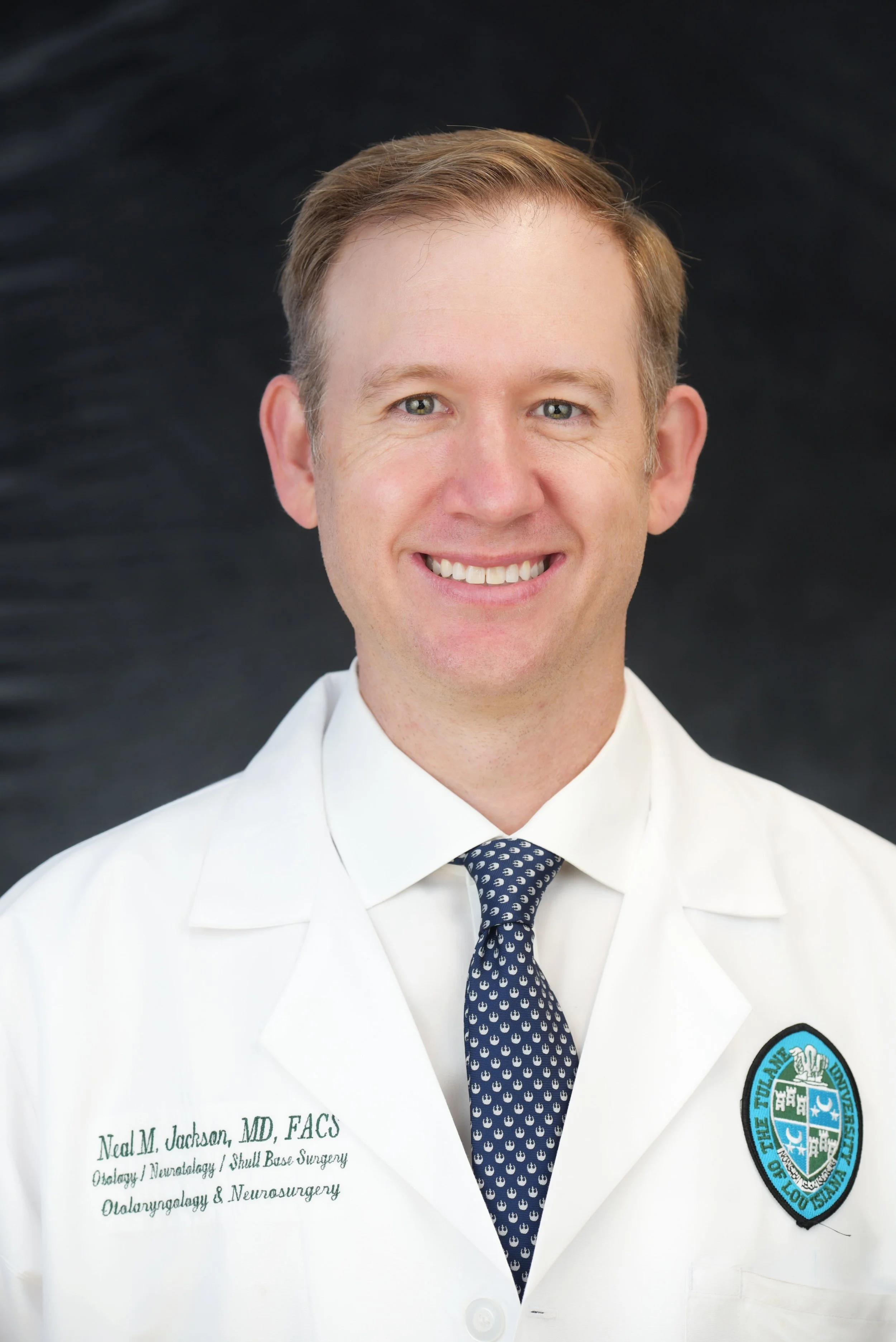
Dr. Neal Jackson is a fellowship-trained neurotologist, a rare subspecialist devoted specifically to disorders of hearing, the ear, and the lateral skull base. His practice is centered on conditions where anatomy is delicate, decision-making is nuanced, and experience can make a meaningful difference in both safety and long-term outcomes.
He cares for both adults and children across the Gulf South, with a practice focused on cochlear implants, chronic ear disease, hearing restoration surgery, and skull base conditions involving the ear. He trained at Michigan Ear Institute, one of the largest neurotology practices in the country, with strong emphasis on skull base surgery, chronic ear disease, and cochlear implant surgery. Patients and families benefit from a specialist whose work is concentrated in this anatomy every day.
What is a neurotologist?
A neurotologist is an ear specialist with additional fellowship training in complex hearing disorders, chronic ear disease, ear reconstruction, cochlear implants, some balance disorders, and lateral skull base surgery.
That subspecialty matters because many important ear diagnoses are not simply routine ENT problems. They involve hearing preservation, fine middle ear and inner ear anatomy, skull base judgment, and operations that demand both precision and experience.
A focused surgical practice
Dr. Jackson’s practice includes high-volume ear surgery, cochlear implantation, chronic ear disease surgery, revision ear surgery, hearing restoration procedures, and skull base work when appropriate. This is not a broad general ENT practice with occasional ear surgery. It is a focused specialty practice built around hearing and ear disease.
That concentration matters because outcomes are shaped not only by technical skill, but also by the ability to recognize patterns, make sound treatment decisions, and anticipate the anatomic and long-term issues that come with complex ear conditions.
Care for adults and children
Dr. Jackson treats both adult and pediatric patients. Some families arrive with a new diagnosis and need clear guidance. Some adult patients have been dealing with hearing loss, chronic drainage, or prior surgery for years before reaching a specialist evaluation.
A major strength of neurotology is the ability to bring the same focused expertise to a wide range of ages while still tailoring care to the patient’s stage of life, hearing goals, anatomy, and diagnosis.
Collaboration when it matters
Many ear and hearing problems can be treated entirely within a neurotology practice. Some skull base problems are best treated in collaboration with neurosurgery, depending on the diagnosis, anatomy, and surgical goals.
Patients also benefit from collaboration with audiologists at many institutions, because proper evaluation and treatment of hearing loss, cochlear implant candidacy, follow-up care, and other complex hearing issues often depend on a strong multidisciplinary approach. Dr. Jackson’s practice is built not only around surgical judgment, but also around coordinated care with the hearing professionals who help guide diagnosis, treatment planning, and long-term outcomes.
How he approaches patient care
The right treatment is not always surgery. In many situations, the most important first step is careful evaluation, review of hearing testing and imaging, and a clear explanation of what the diagnosis means and what options exist.
When surgery is needed, the goal is not only to perform the operation well, but to create the right long-term plan for hearing, disease control, follow-up, and quality of life. Patients deserve care that is both highly specialized and understandable.
Why patients and referring doctors seek him out
Patients, families, and referring physicians often seek Dr. Jackson because his practice combines rare subspecialty training with focused daily experience in complex ear and hearing problems. He has been recognized as a Castle Connolly Top Doctor in ENT every year since first becoming eligible, a reflection of sustained peer recognition over time.
For conditions such as cochlear implantation, cholesteatoma, chronic ear reconstruction, acoustic neuroma, and skull base ear disorders, patients benefit from seeing a specialist whose work is centered in exactly that space. He also continues to publish research in anatomy and skull base surgery techniques and routinely gives expert-level educational talks to ENT physicians in the city and across the region, reinforcing a practice that is not only clinically active, but deeply engaged in advancing specialty knowledge.